

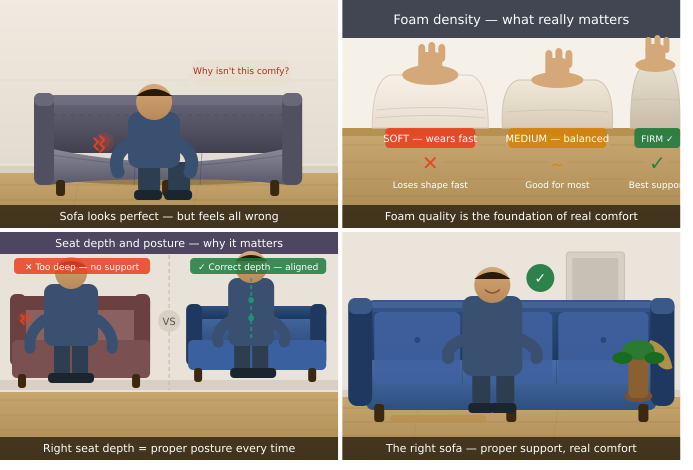
Why Your Sofa Looks Perfect But Feels Uncomfortable And What Most People Only Realise Too Late
Sofa uncomfortable Bradford is a common issue where a sofa can look perfect in your home but still feel uncomfortable because comfort depends on internal structure, not appearance. In many homes across Bradford, sofas that seem ideal at first quickly become tiring to sit on due to poor foam quality, incorrect seat depth, and lack of proper support. Understanding what actually creates comfort is the key to getting it right.
✅ TL;DR
-
-
- Comfort comes from foam, depth, and support not just design
- Sofas that feel soft at first often become uncomfortable later
- Seat depth and posture play a major role in daily comfort
- Poor internal build leads to long term discomfort
- The right combination of materials changes everything
-
Here is the moment most people recognise the problem
It usually does not happen straight away.
At first, the sofa looks great. It fits the room nicely. The colour works. Everything feels right visually.
Then after a few days, something feels slightly off.
You sit down after a long day and shift around more than you expected.
You lean back and do not feel properly supported.
You get up and think:
“Why does this not feel as comfortable as I thought it would be?”
That quiet frustration builds over time.
We hear this exact situation from customers across Leeds and Halifax all the time.
Why does a sofa feel comfortable at first but not later
Because initial comfort and lasting comfort are two completely different things
This is where most people get caught out.
What happens in reality
-
-
- Sofas are often designed to feel soft in a showroom
- Soft foam gives an immediate impression of comfort
- But that softness lacks long term support
-
After repeated use:
-
-
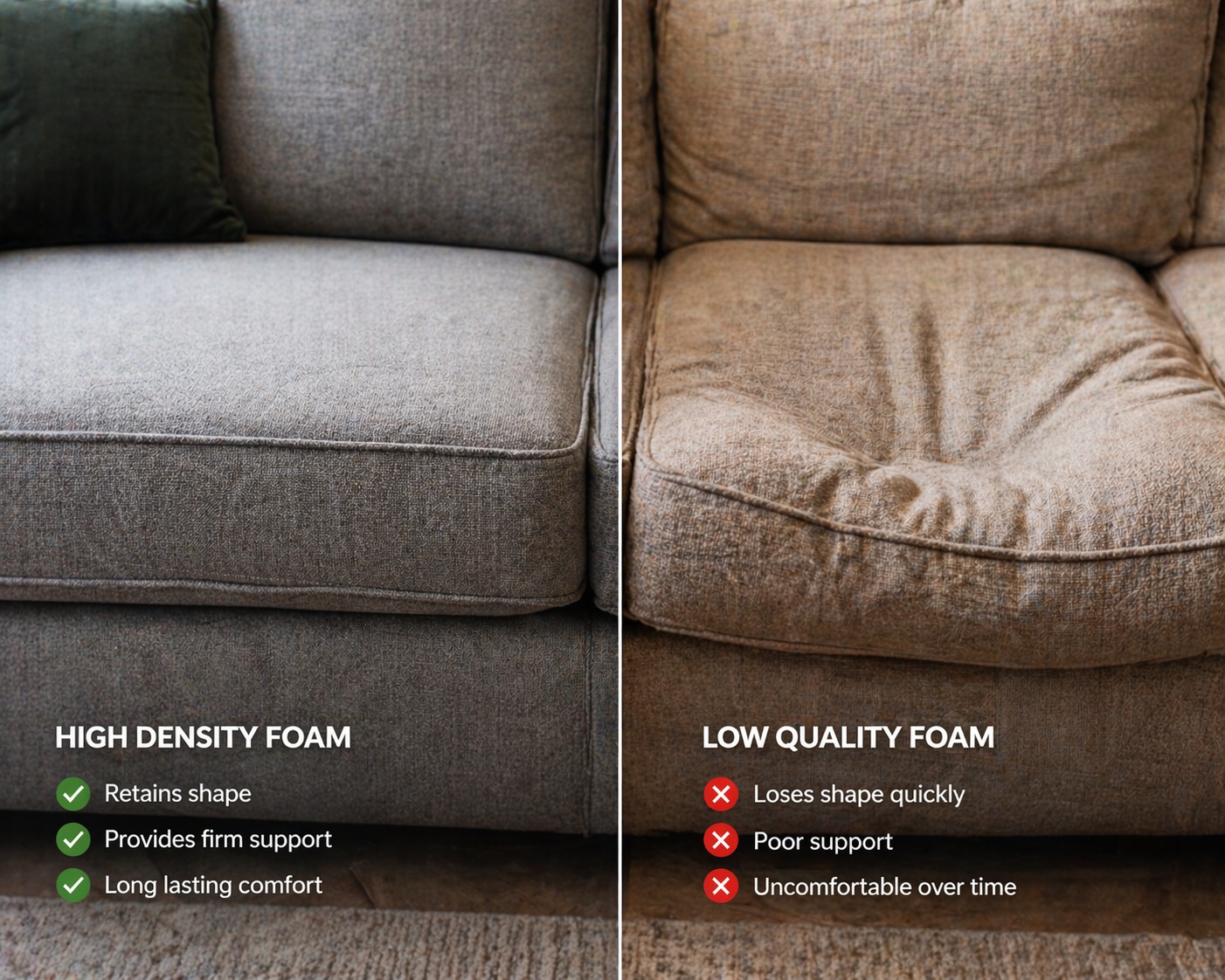
- The foam compresses
- Support disappears
- Posture becomes uncomfortable
-
Real example
A customer from Bradford bought a soft sofa because it felt cosy in store.
A few weeks later:
-
-
- It felt too low
- It was harder to get up from
- It offered no back support
-
That initial comfort turned into daily discomfort.
The three things that actually control comfort
1. Foam quality and firmness
Foam is the foundation of comfort.
There are generally three types:
-
-
- Soft
- Medium
- Firm
-
Each has its place, but here is the truth:
Soft foam feels good immediately but wears out faster.
Medium to firm foam:
-
-
- Holds shape better
- Supports your body properly
- Improves comfort over time
-
2. Seat depth and height
This is one of the most overlooked factors.
If a seat is too deep:
-
-
- You slump forward
- Your back loses support
-
If it is too shallow:
-
-
- You feel restricted
- You cannot relax properly
-
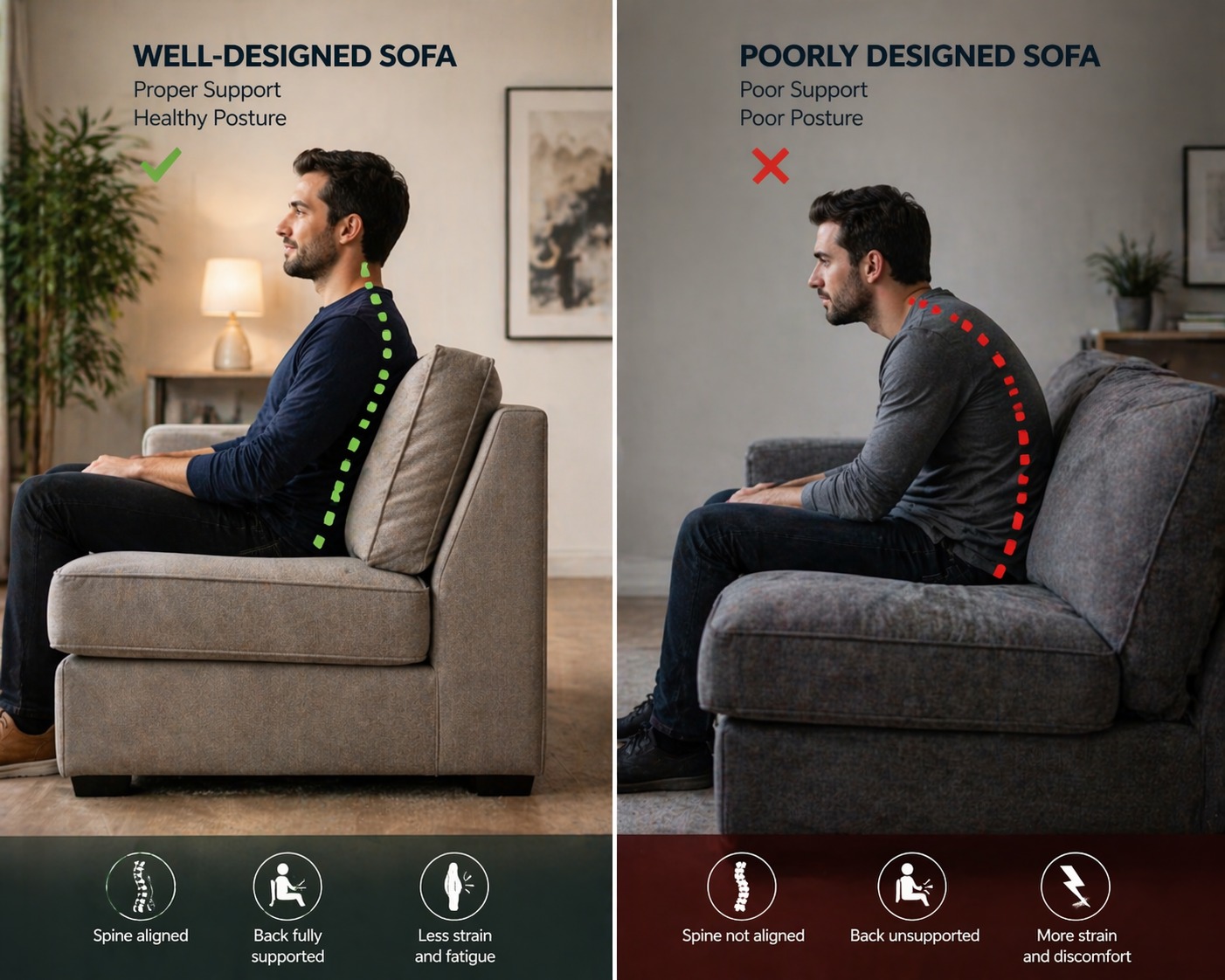
Comfort comes from alignment.
Your back, hips, and legs should all feel naturally supported.
3. Back support and structure
A sofa is not just about the seat.
Back support determines:
-
-
- Posture
- Relaxation
- Long term comfort
-
Poorly designed backrests:
-
-
- Push you forward
- Create tension in your shoulders
-
Proper support feels natural. You do not have to think about it.
Why this issue is so common in Yorkshire homes
Homes across:
-
-
- Bradford
- Huddersfield
- Leeds
-
are used heavily.
This is not occasional furniture use.
This is:
-
-
- Daily lounging
- Family gatherings
- Even working from the sofa
-
So when a sofa lacks proper support, it becomes noticeable very quickly.

The hidden problem nobody explains
Most sofas are designed to sell visually, not to support your body properly.
Let me be honest.
Design sells.
Comfort requires engineering.
That means:
-
-
- Correct foam density
- Proper seat angles
- Balanced support
-
These are not things you see in photos.
The posture problem people do not notice
Here is something subtle but important.
If your sofa:
-
-
- Forces you to lean forward
- Makes you shift constantly
- Leaves your lower back unsupported
-
Then it is working against your body.
Over time, this leads to:
-
-
- Discomfort
- Restlessness
- Even minor aches
-
A good sofa should feel natural.
Not something you have to adjust to.
Why people choose the wrong comfort level
It comes down to one moment.
You sit in a showroom for five minutes.
You choose what feels good instantly.
But you are not testing:
-
-
- Long-term sitting
- Daily use
- Posture support
-
That is where the mistake happens.
A better way to think about comfort
Instead of asking:
“What feels soft right now”
Ask:
“What will feel supportive after an hour”
That shift changes everything.
Real scenario that changes perspective
A couple from Halifax were choosing between two sofas.
One was softer and felt comfortable immediately.
The other was medium firm.
They chose the medium firm option.
A few weeks later:
-
-
- It held its shape
- It supported properly
- It became more comfortable over time
-
That is the difference between short term comfort and lasting comfort.
Checklist before choosing a comfortable sofa
Ask yourself:
✅ Does this support my lower back properly.
✅ Can I sit here comfortably for a long period.
✅ Does the seat depth suit my height.
✅ What type of foam is used.
✅ Will this hold its shape over time.
If you cannot answer these confidently, it is worth reconsidering.
Where most people finally understand comfort
It usually happens after living with the wrong sofa.
After:
-
-
- Constant shifting
- Feeling uncomfortable during relaxation
- Realising something is not right
-
That is when people start looking deeper.
Not just at how furniture looks.
But how it actually performs.
Final thought
A sofa is not just something you sit on.
It is where you:
-
-
- Relax
- Unwind
- Spend time every day
-
If it is not comfortable, you feel it constantly.
Not in a dramatic way.
But in small, repeated moments.
Once you understand what creates real comfort, you stop choosing based on appearance alone.
And start choosing something that actually supports how you live.
👉 If you are choosing a new sofa in Bradford or nearby areas
Take your time.
Sit properly. Test properly.
Think beyond the first impression.
Because real comfort is not something you notice in five minutes.
It is something you appreciate every day.
Frequently Asked Questions
Why does my sofa feel uncomfortable after a while
This is usually due to low quality foam and lack of proper support. Sofas that feel soft initially often lose structure quickly.
What is the best foam for sofa comfort
Medium to high density foam provides the best balance between comfort and durability.
How do I know if a sofa is supportive
A supportive sofa keeps your back aligned and does not force you to adjust your posture constantly.
Is soft or firm better for sofas
Medium to firm sofas tend to provide better long term comfort and support compared to very soft options.
Why do sofas feel different at home than in store
In store testing is short term. At home, prolonged use reveals issues with support, depth, and foam quality.