

Why Most People Choose the Wrong Sofa Size (And End Up Regretting It Within Weeks)
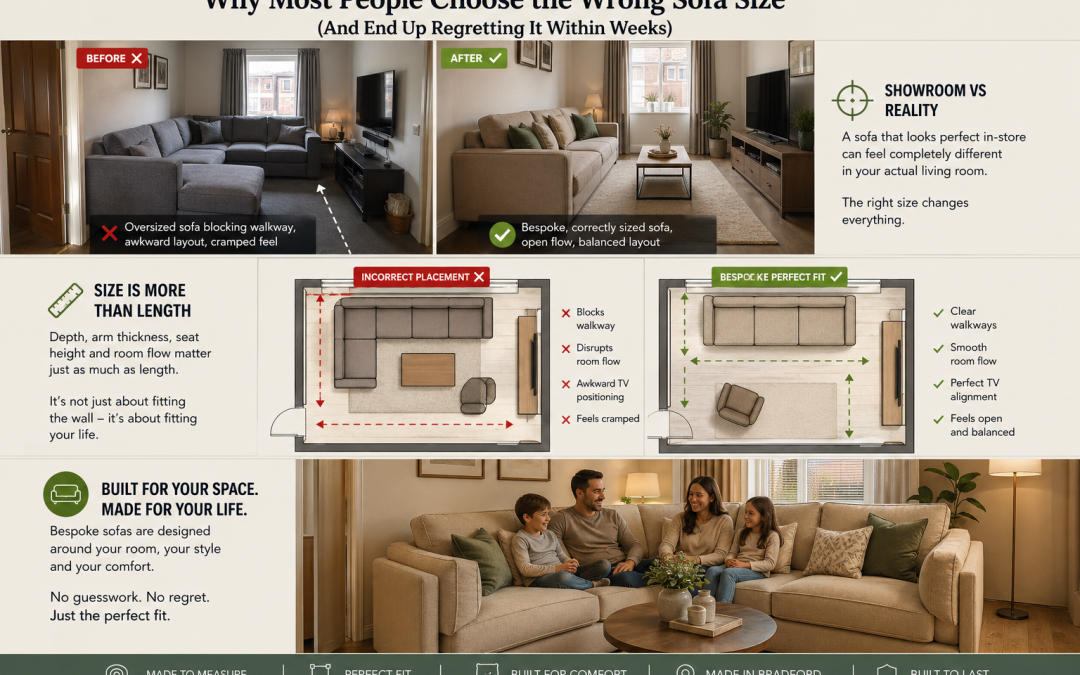
Most people choose the wrong sofa size because they rely on showroom perception instead of real room proportions. A sofa that looks perfect in-store often overwhelms or underwhelms a home once placed in a real living space, leading to frustration, awkward layouts, and costly replacements within months.
✅ TLDR
-
-
- Showrooms distort how sofa size actually feels in a real home
- Most buyers underestimate walking space and room flow
- Sofa depth and arm size matter as much as length
- Bradford homes vary too much for “standard sizing” to work properly
- Made-to-measure sofas eliminate sizing regret completely
-
🌿 Let’s be honest - this mistake happens more often than people admit
Someone walks into a showroom in Bradford.
They see a sofa.
It looks perfect.
Not too big. Not too small. Just right.
They sit on it for 30 seconds and think:
“Yeah… that’ll work in my living room.”
Then delivery day comes.
And suddenly the room feels different.
Tighter. Heavier. Less open.
And that’s when the realisation hits:
The sofa wasn’t wrong… the size assumption was.
🧠 Why sofa size is so misleading in showrooms
Here’s the uncomfortable truth most retailers don’t explain.
Showrooms are designed to inflate comfort and scale accuracy emotionally.
They use:
-
-
- High ceilings
- Wide spacing between furniture
- Neutral, uncluttered layouts
- No visual crowding
-
So your brain interprets the sofa as smaller than it actually is.
At home?
Everything changes instantly:
-
-
- Narrower walkways
- Real walls closing in
- Other furniture already occupying space
- Natural clutter of daily life
-
That same sofa suddenly feels… dominant.
📏 The real issue isn’t sofa length - it’s spatial misjudgement
Most people think sofa sizing is simple:
“Measure the wall, pick something slightly smaller.”
But that’s only part of the equation.
What actually matters is:
-
-
- Sofa depth (how far it projects into the room)
- Arm thickness (adds hidden bulk)
- Seat height (affects visual weight)
- Room flow (how people move around it)
-
And this is where most mistakes happen.
A sofa that fits the wall perfectly can still ruin the room layout.
🏡 A real Bradford scenario (this happens constantly)
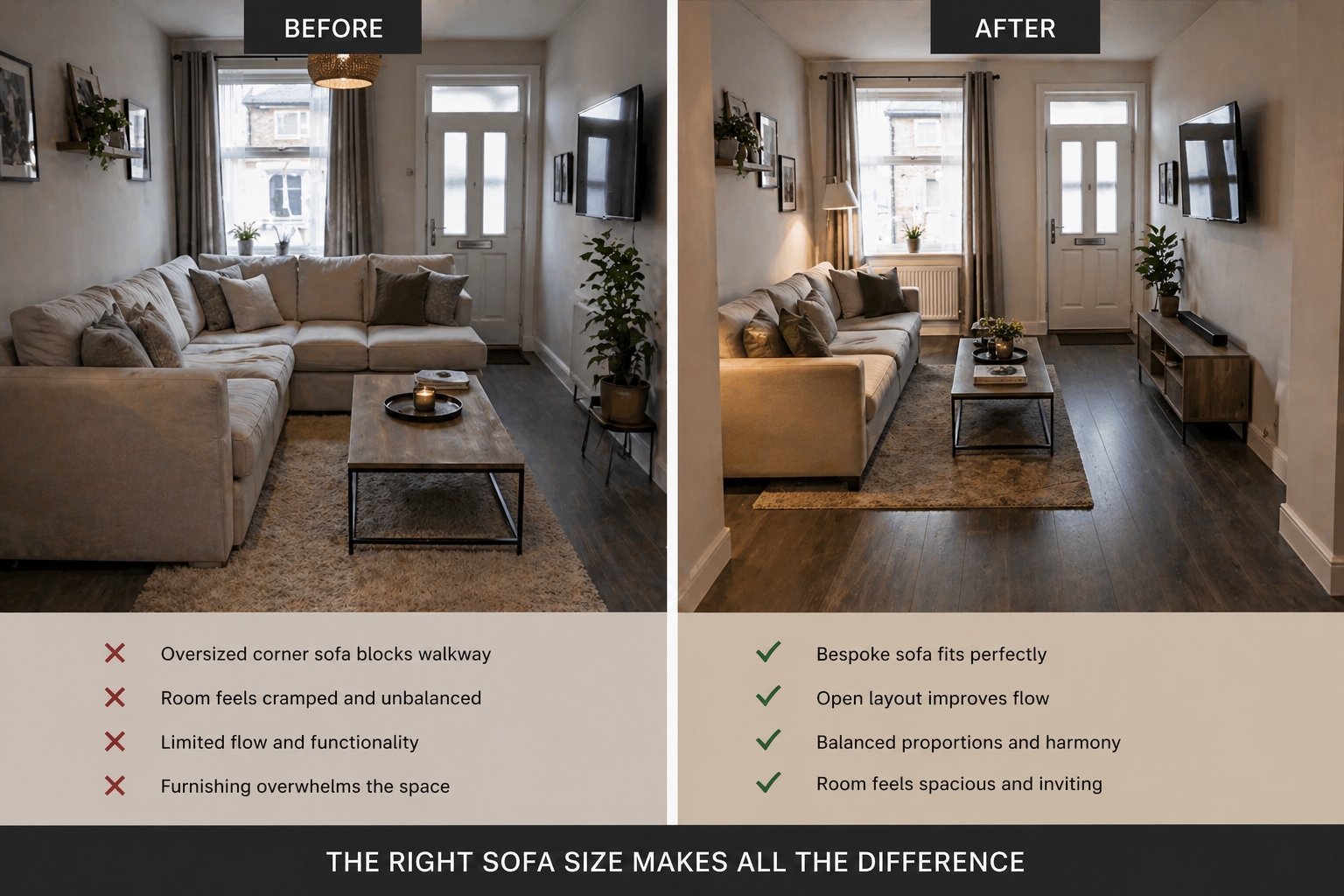
A couple in a terraced Bradford home chose a corner sofa online.
On paper, it fit.
In reality:
-
-
- It blocked half the walkway
- The TV angle became awkward
- The room lost balance
- Chairs had to be removed
-
Nothing was “wrong” with the sofa.
It was simply wrong for the space it entered.
And that’s the part people don’t expect.
📉 Why standard sofa sizes fail in Bradford homes
Bradford homes are not uniform.
You get:
-
-
- Narrow Victorian terraces
- Extended family homes
- New build apartments with open plans
- Odd-shaped living rooms with angled walls
-
That creates one major problem:
Standard sofa sizing is designed for average homes that don’t really exist.
So homeowners end up compromising:
-
-
- Too big → room feels cramped
- Too small → room feels empty
- “Almost right” → still slightly off
-
That “almost” is what causes regret.
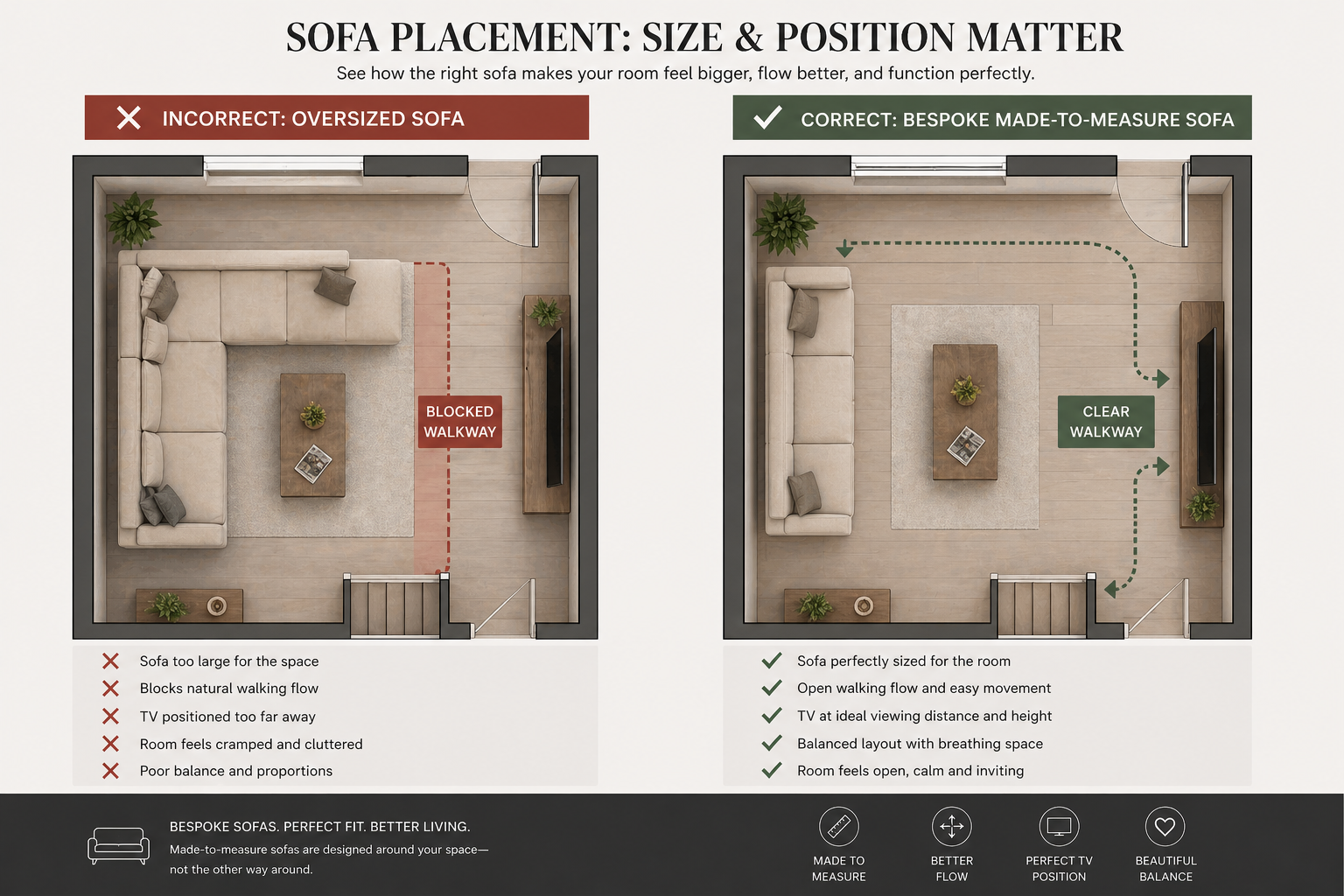
🧩 The hidden mistake: ignoring room flow
Here’s something most people never measure properly:
Walking space.
A sofa doesn’t just sit in a room, it controls movement.
If space flow is disrupted:
-
-
- The room feels smaller
- Movement becomes awkward
- Furniture feels intrusive
-
Even a perfect-looking sofa becomes frustrating over time.
🔍 Why sofas feel smaller in-store (but bigger at home)
This is pure perception psychology:
In-store:
-
-
- Open environment
- No visual boundaries
- Furniture feels isolated
-
At home:
-
-
- Defined walls
- Limited spacing
- Multiple objects competing visually
-
So your brain recalibrates instantly.
What felt “medium-sized” becomes “large presence.”
🛠️ Where bespoke sofas completely change the outcome
This is where made-to-measure sofas (like M I Furniture produces in Bradford) completely remove the guesswork.
Instead of choosing from fixed sizes, you control:
-
-
- Exact width
- Exact depth
- Arm style (slim vs wide)
- Seat height
- Layout shape
-
So the sofa is not “fitted into the room.”
It is designed for the room.
That single shift eliminates most sizing regret.
⚠️ The most common sofa sizing mistakes (quick checklist)
If you’re buying a sofa, watch for this:
✅ Only measuring wall length (not depth)
✅ Ignoring door clearance paths
✅ Forgetting walking routes
✅ Overestimating visual space in showroom
✅ Choosing style before size fit
✅ Not accounting for arm thickness
One of these alone can change everything.
🛋️ Why sofa depth matters more than people think
Depth affects:
-
-
- Comfort posture
- Visual bulk
- Room dominance
- Walking clearance
-
A deep sofa in a small room feels much larger than it actually is.
That’s why two sofas of the same length can behave completely differently in a space.
🧠 The emotional regret pattern (what happens after delivery)
Most customers go through the same cycle:
-
-
- Excitement at purchase
- Confidence in showroom
- Slight doubt on delivery
- Reality hits after placement
- “We should have gone smaller…”
-
That regret is not about taste.
It’s about lack of spatial accuracy before buying.
🏁 Why bespoke removes regret completely
Here’s the key difference:
Standard sofa buying = guessing
Bespoke sofa buying = designing
When you go bespoke:
-
-
- Measurements are exact
- Room flow is considered
- Lifestyle usage is factored in
- Comfort preferences are built in
-
So there is no “hope it fits.”
There is only:
“It’s made for here.”
🧭 Final thought
Most sofa regret doesn’t come from bad taste.
It comes from bad scale judgement in a controlled showroom environment.
Once you understand that, everything changes.
You stop asking:
“Does this sofa look good?”
And start asking:
“Does this sofa actually belong in my space?”
That is the shift that separates impulse buying from long-term satisfaction.
And in 2026, that shift is exactly why made-to-measure furniture is becoming the smarter choice across Bradford homes.
Frequently Asked Questions
Why do sofas look smaller in the showroom?
Because showrooms are open, uncluttered spaces that visually reduce perceived size compared to real homes.
What is the biggest sofa sizing mistake?
Ignoring room depth and walking space – not just wall length.
Do corner sofas always make rooms smaller?
Not always, but incorrectly sized corner sofas can dominate space and reduce flow significantly.
Is bespoke sofa sizing worth it?
Yes, because it removes guesswork and ensures exact fit for your room layout and lifestyle.
How do I avoid buying the wrong sofa size?
Measure full room flow, not just wall space, and consider professional made-to-measure options.